Author: TechStreet

  • Beating the Agentic AI Resume Screeners in 2026

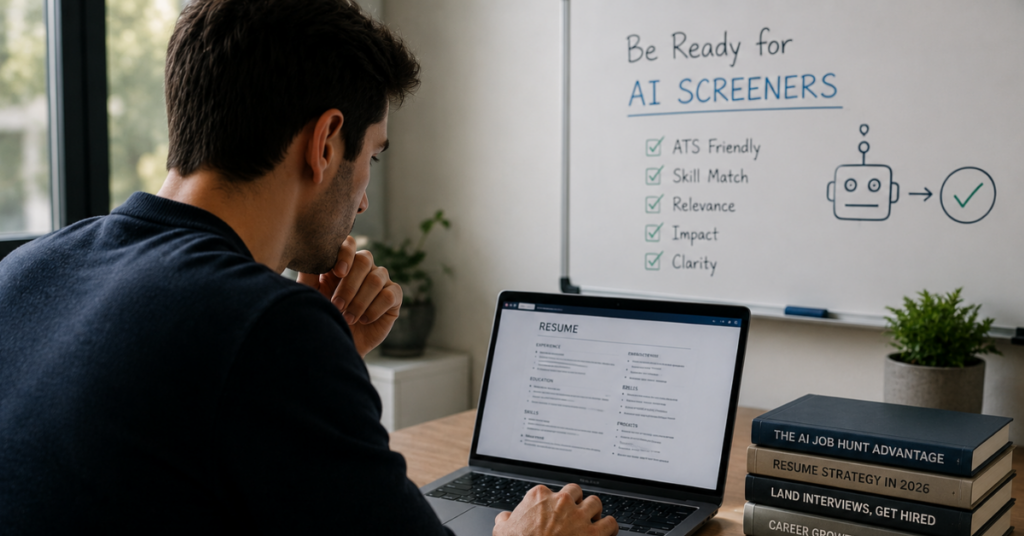
    Professional job seeker optimizing a resume on a laptop while preparing for AI-powered resume screening and recruitment systems in 2026.

    For years, candidates optimised their resumes by inserting keywords designed to satisfy Applicant Tracking Systems (ATS).

    That approach is rapidly becoming obsolete.

    In 2026, recruitment technology has evolved far beyond simple keyword matching. Modern hiring platforms increasingly leverage Agentic AI systems capable of analysing career trajectories, predicting future performance, evaluating communication effectiveness, identifying leadership potential, and estimating long-term retention likelihood.

    For job seekers, this changes everything.

    Candidates who continue relying on keyword stuffing and generic resume templates risk being filtered out before a recruiter ever reviews their application.

    Success in today’s hiring market requires a new mindset: writing resumes that resonate with both intelligent AI systems and human decision-makers.

    What Makes Agentic AI Recruitment Different?

    AI No Longer Looks for Keywords Alone

    Modern recruitment AI evaluates a much broader set of signals, including:

    • Problem-solving capability
    • Career progression
    • Leadership potential
    • Technical expertise
    • Communication effectiveness
    • Adaptability and learning agility
    • Project ownership
    • Consistency of impact

    Instead of simply identifying specific terms, these systems analyse context, achievements, and patterns across a candidate’s career history.

    For example, consider the difference between:

    “Responsible for managing cloud infrastructure.”

    and

    “Reduced cloud infrastructure costs by 28% through automated workload optimisation.”

    The first describes a responsibility.

    The second demonstrates measurable business impact.

    That distinction can significantly influence how AI systems assess candidate quality.

    Why Responsibilities Are No Longer Enough

    Impact Metrics Are the New Currency

    One of the most common resume mistakes in 2026 is focusing on duties rather than outcomes.

    Today’s hiring systems are increasingly trained to identify evidence of business value and measurable performance.

    Instead of writing:

    • Managed DevOps workflows
    • Worked with cybersecurity teams
    • Participated in AI deployment projects

    Consider highlighting outcomes instead:

    • Reduced deployment failures by 46%
    • Eliminated security vulnerabilities across three cloud regions
    • Reduced AI model deployment time from 12 hours to 35 minutes

    Metrics create credibility.

    More importantly, they help both AI systems and recruiters understand the scale of your contribution and predict future performance.

    How to Improve ATS Performance in 2026

    Use Role-Specific Language Naturally

    Many candidates still copy keywords directly from job descriptions.

    Modern AI systems are increasingly capable of detecting unnatural optimisation patterns.

    Instead:

    • Use industry terminology organically
    • Mirror the employer’s language where relevant
    • Demonstrate practical application of skills
    • Connect achievements to business outcomes

    For example, if an employer emphasises:

    • Agentic AI
    • Autonomous orchestration
    • AI governance

    Your resume should showcase genuine experience related to those concepts rather than simply repeating the terms.

    Demonstrate Specialization

    Recruitment AI increasingly rewards depth over breadth.

    Strong candidates often show:

    • Domain expertise
    • Progressive skill development
    • Consistent specialization
    • Long-term focus within a technical area

    A cybersecurity professional specialising in AI threat modeling, cloud security, or governance may stand out more than a general IT practitioner with broader but less focused experience.

    Human-Centric Resume Writing Still Matters

    Recruiters Continue to Hire People, Not Profiles

    While AI plays a growing role in screening, final hiring decisions remain fundamentally human.

    Recruiters and hiring managers still evaluate qualities such as:

    • Leadership
    • Communication
    • Initiative
    • Curiosity
    • Collaboration
    • Adaptability

    The most effective resumes balance machine readability with authentic professional storytelling.

    Turn Achievements Into Stories

    Instead of relying on generic bullet points, frame accomplishments as concise achievement narratives.

    For example:

    “Led a cross-functional AI security initiative that reduced incident response times by 61% during a critical cloud migration.”

    In a single sentence, this demonstrates:

    • Leadership
    • Technical expertise
    • Collaboration
    • Business impact
    • Performance under pressure

    Strong achievement narratives provide far richer signals than simple responsibility statements.

    Resume Structure Best Practices for 2026

    Organise Skills by Expertise Area

    Avoid listing dozens of technologies in a single skills section.

    Instead, group competencies by specialisation.

    AI Infrastructure

    • Kubernetes
    • NVIDIA Triton
    • Distributed inference pipelines

    AI Security

    • Model governance
    • AI risk assessment
    • Adversarial testing

    This approach improves readability for recruiters while helping AI systems better understand your areas of expertise.

    Keep Formatting Simple

    Even advanced recruitment systems can struggle with overly complex resume designs.

    Avoid:

    • Multi-column layouts
    • Heavy graphics
    • Complex tables
    • Embedded visual elements

    Instead, use:

    • Clear section headings
    • Standard fonts
    • Consistent spacing
    • Clean bullet points

    Simple formatting improves both machine readability and human review.

    Final Thoughts

    AI resume optimisation in 2026 is no longer about gaming algorithms.

    It is about communicating value clearly, strategically, and authentically.

    Candidates who demonstrate measurable impact, showcase specialised expertise, and tell compelling professional stories will consistently outperform those relying on outdated ATS tactics.

    The future of hiring belongs to professionals who can prove not only what they did, but why it mattered.

  • The Death of the Generalist: Why Deep Specialisation Wins in 2026

    The Death of the Generalist: Why Deep Specialisation Wins in 2026

    For over a decade, the “full-stack developer” was the gold standard in tech hiring. Companies wanted engineers who could build frontend interfaces, manage backend systems, deploy infrastructure, and even contribute to product strategy.

    That era is rapidly disappearing.

    In June 2026, employers are prioritising precision over breadth. Organisations are no longer hiring “people who can do everything.” Instead, they are aggressively competing for professionals with deep expertise in highly specialised domains such as Agentic AI governance, cloud-native cybersecurity, quantum error correction, and AI infrastructure optimisation.

    The shift is not simply a hiring trend; it is a survival strategy for businesses operating in an AI-driven economy.

    Why Generalist Skills Are Losing Value? AI Tools Have Automated Mid-Level Technical Work

    Modern AI copilots can now generate:

    • CRUD applications
    • API integrations
    • Automated test suites
    • Infrastructure templates
    • Frontend components
    • Database schemas

    As a result, companies no longer need large teams of broad-scope developers handling repetitive implementation work.

    What businesses desperately need are professionals who can solve highly specific, high-risk problems that AI cannot reliably manage alone.

    Examples include:

    • AI ethics compliance engineers
    • Cloud security architects
    • Autonomous systems auditors
    • Quantum computing researchers
    • AI infrastructure performance specialists
    • Edge AI optimisation engineers

    This is why “deep specialisation jobs 2026” has become one of the fastest-growing search trends across tech recruitment platforms.

    The 2026 Layoff Cycle Changed Employer Psychology. The 2025–2026 tech correction forced employers to reevaluate workforce efficiency.

    Companies discovered that:

    • Generalists were easier to replace with AI workflows
    • Specialised experts reduced operational risk
    • Niche technical knowledge accelerated innovation
    • Highly focused professionals delivered stronger ROI

    In short, specialisation became recession-resistant.

    For candidates focused on surviving the 2026 tech layoff environment, becoming deeply specialised is no longer optional.

    The Rise of Niche Tech Careers. The New High-Value Roles.

    The highest-paying tech jobs in 2026 are increasingly concentrated in narrow expertise categories.

    Examples include:

    • Agentic AI Governance Specialists

    These professionals ensure autonomous AI systems comply with regulations, safety policies, and ethical standards.

    • Quantum Error Correction Engineers

    As quantum systems scale commercially, error correction has become one of the industry’s largest bottlenecks.

    • Cloud Threat Modeling Experts

    With AI-powered cyberattacks increasing, companies need professionals who understand predictive security architecture.

    • AI Infrastructure Optimisation Engineers

    Organisations deploying large AI models now require specialists focused solely on inference efficiency and compute cost reduction.

    These are not “general developer” roles.

    These are niche tech careers built around highly specific business problems.

    How to Niche Down Your Resume in 2026. Stop Positioning Yourself as “Versatile”

    In 2026, versatility can unintentionally signal a lack of expertise.

    Instead of writing:

    “Experienced full-stack engineer with broad technical exposure.”

    Write:

    “Cloud security engineer specialising in AI-native threat detection for distributed enterprise systems.”

    Specificity creates credibility.

    Build Around One Core Market Identity

    Your resume should communicate one dominant professional identity within the first 10 seconds.

    Strong examples include:

    “Agentic AI Security Analyst”
    “AI Compliance Engineer”
    “Quantum Systems Developer”
    “Distributed Cloud Security Architect”

    Avoid listing unrelated technical stacks simply to appear more employable.

    Replace Tool Lists with Problem Ownership

    Hiring managers are exhausted by resumes that only list technologies.

    Instead of:

    Python
    • Kubernetes
    AWS
    TensorFlow

    Frame your experience around business outcomes:

    • Reduced AI inference cost by 37%
    • Designed secure multi-agent orchestration framework
    • Built cloud-native threat detection pipeline
    • Improved AI model deployment speed by 42%

    The future belongs to candidates who demonstrate ownership, not exposure.

    The Most Valuable Agentic AI Skills in 2026

    Organisations adopting autonomous AI systems are heavily recruiting professionals with expertise in:

    • Multi-agent orchestration
    • AI governance frameworks
    • AI auditability
    • Model alignment testing
    • Secure AI deployment pipelines
    • Human-in-the-loop systems
    • AI safety engineering

    Candidates who combine technical specialisation with regulatory understanding are especially valuable.

    Final Thoughts

    The technology job market in June 2026 rewards precision.

    Generalists are competing with increasingly capable AI systems. Specialists are solving the complex, high-risk problems businesses cannot automate away.

    The strongest career strategy today is not learning “a little bit of everything.” It is becoming exceptionally valuable in one critical area.

    Professionals who embrace deep specialisation, communicate measurable impact, and align themselves with emerging technical domains will dominate the next era of hiring.